
Key Takeaways
Tire pressure maintenance is a straightforward task with a direct impact on vehicle safety, performance, and operating costs. Here's what every driver needs to know:
- Check tire pressure monthly, when tires are cold – Tires lose 1–2 PSI naturally each month, and pressure shifts by 1 PSI for every 10°F change in temperature. Regular monitoring is essential, not optional.
- TPMS alone is not enough – Studies show only 57% of vehicles with tire pressure monitoring systems have properly inflated tires. These systems don't alert drivers until pressure drops 25% below recommended levels.
- Correct inflation protects both tires and fuel economy – Each 1 PSI drop reduces fuel economy by 0.2%. Proper pressure also prevents premature treadwear and lowers the risk of tire failure.
- Find your vehicle's recommended PSI on the door jamb – The correct pressure, typically 30–35 PSI for most passenger vehicles, is listed on the driver's side door sticker or owner's manual. The maximum pressure on the tire sidewall is not the target operating pressure.
- Use a quality gage and check every tire – A reliable digital or dial gage ($10–20) provides accurate readings. Always check all four tires and the spare, since front and rear tires may call for different pressures.
About 25% of vehicles on the road have at least one significantly underinflated tire, yet only 19% of drivers check tire pressure correctly. Tires lose up to 1 PSI each month through natural air seepage alone, and both underinflation and overinflation accelerate treadwear and raise the risk of tire failure. Proper inflation delivers measurable benefits: longer tire life, improved fuel efficiency, better steering response, and a more consistent ride. This guide covers the full process—what PSI your tires should be, what tools you need, and how to check accurately every time.
What You Need to Check Tire Pressure
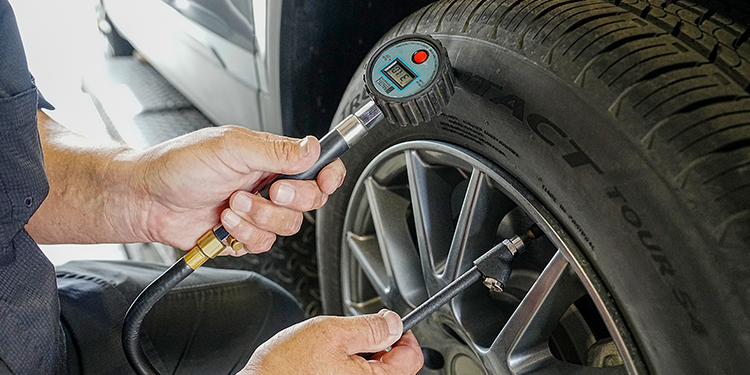
A tire pressure gage is the one tool you need to get started. Three formats are available: analog dial gages, digital gages, and pencil-style stick gages. Analog dial gages display readings on a circular face and require no batteries, making them reliable and durable over time. Digital gages use backlit LCD screens for clear readings in low-light conditions but do require battery power. Pencil-style stick gages are the most compact option, though they can be harder to read and slightly less accurate than the other two. Dial and digital models generally deliver more consistent accuracy. Quality gages from either category cost between $10 and $20 — a reasonable investment for a tool used every month.
An air compressor is also necessary to correct pressure after measuring. Most gas stations and auto service centers provide air pumps, often at no cost or a minimal fee. Many newer pump units include a built-in gage, which simplifies the process.
Before checking pressure, confirm the recommended PSI for your vehicle. That figure is printed on the sticker inside the driver's side door jamb or listed in the owner's manual. Some vehicles also show it on the fuel filler door. For most passenger vehicles, the recommended range falls between 30 and 35 PSI. One important distinction: that number is not the same as the maximum pressure molded into the tire's sidewall. The sidewall figure represents the tire's upper structural limit — not the pressure your vehicle is engineered to run on.
How to Check Tire Pressure: Step-by-Step Process
Start with your vehicle parked on level ground and tires that are cold. Cold means the vehicle has been stationary for at least three hours, or driven under a mile at moderate speed. Driving raises tire temperature and pressure by several PSI—enough to skew your readings.
Follow these steps:
- Remove the valve cap from the valve stem and set it somewhere you won't lose it. A stuck cap responds well to spray lubricant—grip the base with pliers and twist the cap free.
- Press the gage firmly onto the valve stem until the hissing stops. A proper seal is essential for an accurate reading.
- Read the pressure. Digital gages display the PSI on screen; analog models use a dial or sliding bar.
- Add air if the reading is low. Attach the compressor hose securely to the valve stem and inflate to your vehicle's recommended PSI. Check the pressure at regular intervals during inflation rather than filling continuously.
- Release air if overinflated by pressing the small pin inside the valve stem. Work in short bursts and recheck between each release.
- Repeat for all four tires and the spare. Front and rear tires often carry different pressure specifications—check each one individually.
- Reinstall the valve caps securely. They maintain pressure integrity and keep debris out of the valve stem.
Understanding Tire Pressure Basics
Tire pressure operates as a foundational variable in vehicle performance—one that affects safety, fuel consumption, and component longevity simultaneously. Underinflated tires generate excess rolling resistance, placing additional load on the engine and increasing fuel burn. The measurable result: each 1 PSI drop in average tire pressure reduces fuel economy by 0.2%. Tires lose 1 to 2 PSI each month through natural air seepage, which means pressure degradation is ongoing and predictable—not an occasional concern.
Temperature adds a separate, compounding factor. Tire pressure shifts approximately 1 PSI for every 10°F change in ambient temperature. Cold air contracts, pulling pressure down; warm air expands, pushing it up. This is precisely why cold-tire readings are the standard for accurate measurement—they reflect true resting pressure before heat from driving skews the result.
TPMS provides a useful alert layer, but it is not a substitute for manual checks. NHTSA data shows that only 57% of vehicles equipped with TPMS actually maintained correctly inflated tires. The system is designed to warn at 25% below the recommended pressure threshold—by which point the tire is already operating outside its optimal range. NHTSA data also found that 50% of tire-related crashes involved single vehicles, a figure that underscores the real-world consequences of ignored pressure degradation.
Only 19% of drivers check and inflate their tires correctly, and approximately 25% of vehicles on the road have at least one significantly underinflated tire. Monthly checks—and verification before long trips—are the minimum standard for maintaining tire integrity and consistent vehicle performance.
Conclusion
You now have everything you need to check and maintain proper tire pressure. The process takes just a few minutes each month, yet the benefits are substantial: better fuel economy, extended tire life, improved safety, and smoother handling. First thing to remember is that your TPMS isn't enough on its own.
Grab a quality tire gage today and make monthly pressure checks part of your routine. Your wallet, your tires, and your safety will thank you for it.
FAQs
Q1. How often should I check my tire pressure? You should check your tire pressure at least once a month and before long trips. Tires naturally lose 1 to 2 PSI each month due to air seepage, and temperature changes can also affect pressure levels. Regular monthly checks help maintain optimal performance, fuel efficiency, and safety.
Q2. Where can I find the correct tire pressure for my vehicle? The recommended tire pressure is listed on a sticker inside the driver's side door jamb, in your vehicle's owner's manual, or sometimes on the fuel filler door. Most passenger vehicles require between 30 and 35 PSI. Never use the maximum pressure printed on the tire's sidewall, as this indicates the tire's upper limit, not the optimal operating pressure for your specific vehicle.
Q3. Should I check tire pressure when the tires are hot or cold? Always check tire pressure when tires are cold for the most accurate readings. Tires are considered cold when the vehicle has been parked for three hours or more, or driven less than a mile at moderate speed. Driving heats up tires and can raise pressure by several PSI, leading to inaccurate measurements.
Q4. What type of tire pressure gage should I buy? Quality tire pressure gages typically cost between $10 and $20 and come in three main types: digital gages with easy-to-read LCD screens, analog dial gages that are durable and don't require batteries, and pencil-style stick gages that are compact but less accurate. Digital and dial gages are generally more accurate than pencil versions.
Q5. Can I rely on my car's Tire Pressure Monitoring System (TPMS) instead of manually checking? You shouldn't rely solely on TPMS. These systems typically don't alert drivers until pressure drops 25% below recommended levels, and studies show that only 57% of vehicles with TPMS have correctly inflated tires. Manual monthly checks with a tire pressure gage are essential for maintaining optimal tire pressure and vehicle safety.